Salmon, Starbucks and the Space Needle are three things the city of Seattle is known for, but the capital of Washington state also has a thriving tea scene.
Twenty years ago, the first time I visited Seattle, I made a pilgrimage of sorts to the ‘original’ Starbucks store in Pike Place Market. I don’t really care for coffee but Seattle had famously exported the brand to the rest of the world so, along with a trip up the Space Needle and a wander through the market, a pumpkin spice latte at the café with the mermaid logo seemed touristically appropriate.
On my second trip this summer just passed, I had a vastly different objective: to visit as many teahouses and tea shops as possible. Armed with an ORCA card, Google Maps and a bunch of recommendations from local friends I met through international tea groups, I hit up about a dozen places.
For a city that supposedly runs on coffee, Seattle outpaces many bigger cities for number of teahouses proportional to population, with an impressive breadth of market segmentation. There’s the classic retail outfit of Perennial Tea Room in Pike Place Market, where large tins of tea sit behind a counter until customer requests are weighed to order. A different demographic altogether can be found at Friday Afternoon Tea in Wallingford; blends are created via synaesthesia and are often named after fandoms. Or you might see tall cups of bubble tea emerging from the doors of Seattle Best Tea or Young Tea, only to discover gongfu tables embedded at the back of those venues.
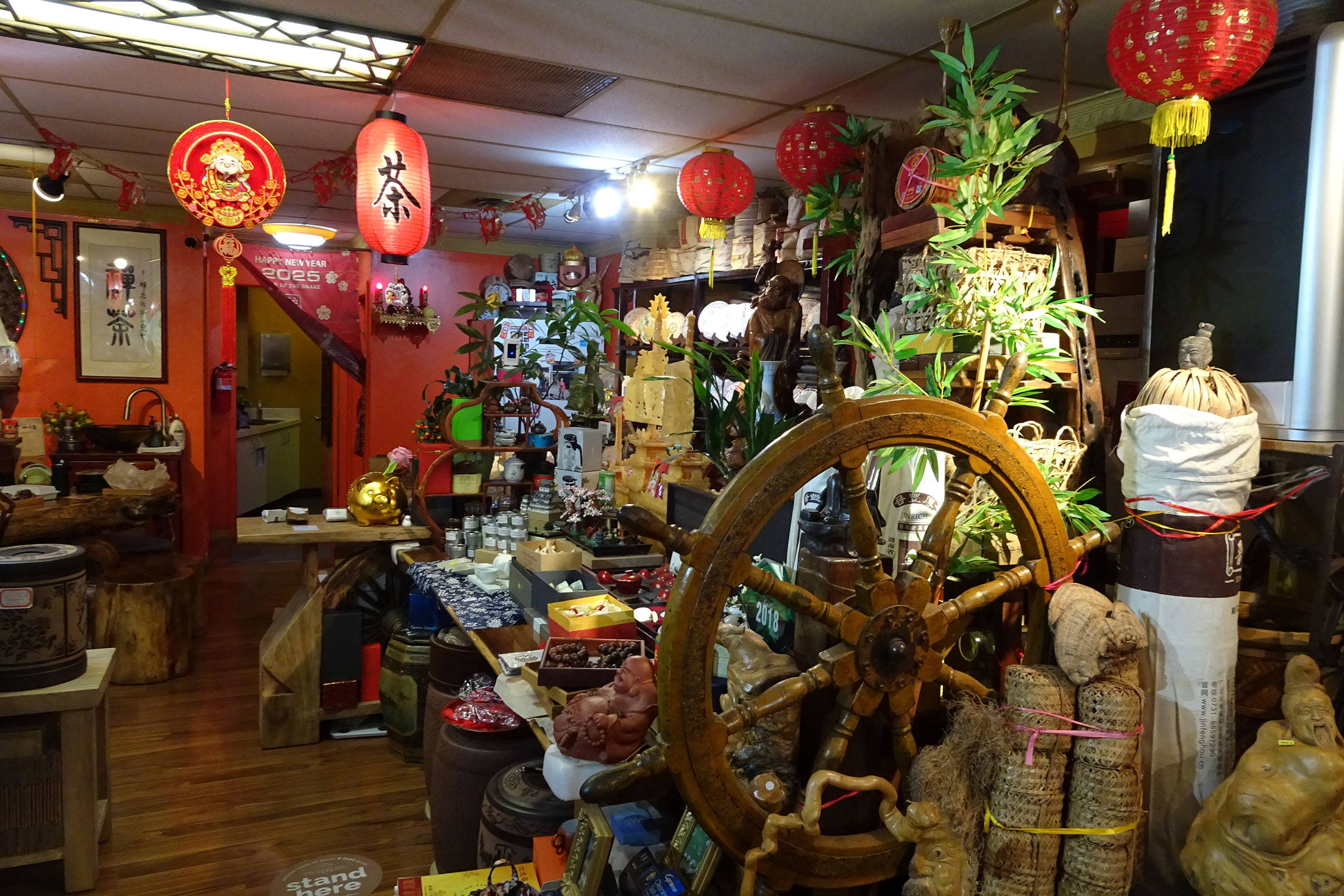
I was determined to pinpoint the genesis of Seattle’s tea scene and found myself sipping samples at New Century Gallery in the International District (i.e. Chinatown). Established in 1999, the shop belongs to Grace Li and Dafe Chen, whose Guangdong-based tea-growing family supplies the more singular teas on offer. At the table I meet a man who has recently moved to Seattle from Reno and who suggests that, at the very least, the local water is much better suited to tea than his former city.
Chen says that when they first opened, the main clientele were Asian people looking to stock up on tea they were already familiar with. Today, despite the shop’s location, many of the people who walk through the door are not Asian and they are open to trying and buying tea they’ve never had before. I walk away with a wild purple leaf pu’er and a couple of teas produced by Chen’s family.
Serious about tea
At the other end of town in the leafy northern neighbourhood of Ballard, near the fish ladder where salmon begin their journey upstream to spawn, is a completely different style of teahouse. Miro, with its white walls, blond wood furniture and lush greenery might, at a passing glance, be mistaken for something more Nordic in nature. The venue is owned by Jeannie Liu, who has Chinese heritage but offers a cosmopolitan range of single estate teas from around the world. On my first visit I have lemon and lavender cake accompanied by the Corsley Nilgiri black tea, which comes ready-brewed in a large mug. Later in the week, when I return with local friends, we share a sheng pu’er and request it gongfu style, where it’s delivered on a tray with a gaiwan, fairness pitcher, three cups and a thermos of hot water. Miro shows that it’s possible to be serious and versatile about tea while still making it attractive and accessible to newcomers.
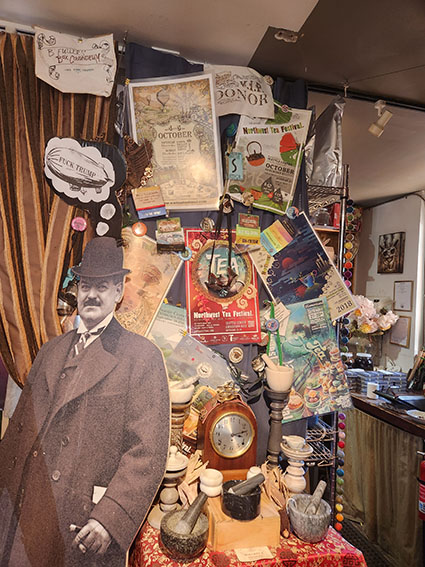
By now I’m a few days into my odyssey and I’ve learnt not to judge a tea shop by its aesthetic. That’s certainly true of B Fuller’s Mortar & Pestle in Fremont, which presents as a steampunk apothecary but also offers a not-so-secret collection of pu’er. B Fuller’s was started by friends of current proprietor William Sullivan 16 years ago, but he’s been running the show virtually solo for the last 13.
Sullivan admits he never got a straight answer as to why the shop is steampunk themed. One of the original owners had a Ren Faire clothing company and did the Ren Faire circuit. “He liked to dress up and then it was just being weirdos – they were just incapable of being normal. When you show up at an event wearing the top hat and goggles, people are gonna notice.”
Another founder was a herbalist, hence the plethora of herbal infusions at the core of the brand’s inventory. Having pu’er in the mix isn’t so strange when you consider its roots, he says. “ If you know the history of it in Chinese culture, it started as a medicine. Tea fits completely into that larger realm of therapeutic herbs.”
This is also part of Seattle’s origin story as a tea-drinking city, Sullivan believes. “I think in the sixties with the hippie counterculture – back to nature, this whole wider spectrum of social movements – people became aware of healthier food and environmentalism, and the sourcing of this.
“Also because we’re Pacific Rim there is more cultural contact between East Asia, traditional tea-drinking countries, and us,” he adds.
One person who has brought East Asian tea to Seattle is Shiuwen Tai, owner of Floating Leaves. A couple of decades ago, Tai had a sizeable teahouse where people would hang out, with musicians playing on the weekends. Life intervened and she was unable to continue with the business; instead, she found her current location in Ballard and opened a smaller scale shop where the tea table is reserved for workshops.
Floating Leaves specialises in Taiwanese oolongs, but is not just an importer. Tai and her partner Noah Baseleon-Abbott have dedicated years of study to learn how to roast their own, making the tea at their store a Seattle signature.
Twenty years ago, Tai spent a lot of time educating the market, explaining the difference between white tea, green tea, black tea and oolong before she could even specify the characteristics of Taiwanese oolongs. These days she’s pleased that the general baseline of tea education has risen and she can jump straight to tea quality, structure and flavour in a method she calls body-based tea appreciation.
“Since Seattle has so much high-tech business, it’s really good for them because they can bring the experience back inside of their body. Tea offers us the opportunity to not just connect with people, which is great, but connect with oneself,” she says.
Seattle’s tea journey has also been one of sharing and discovery, she observes. “ I think people here, people in the Northwest, are nerdy in a very interesting way. When they discover something that they can learn about, they will do it. There’s a lot of energy coming into this community because there are a lot of new people moving into this city; more people are getting more and more interested in and exposed to tea, so I would say the feeling is very robust, very optimistic.”
Her own interest is simple though, as I’ve come to learn on my survey of the Seattle tea scene, there’s a vastness and complexity that belies her words. “I love the plant,” says Tai. “I love the people who make it and produce it. And I love how people dedicate their lifetime to learn this plant.”
This was initially written in September 2025 for Tea Journey magazine ahead of the Northwest Tea Festival. but was not accepted for publication in time. See the primer article I posted at the time.