Farmer or god? Explorer or emperor? Meet medicine man, inventor of the calendar and son of a dragon (maybe), Shennong.
There are many myths and legends about tea, and the one about the OG (original god) is a doozy. My favourite version, for there are always many versions on a theme, involves a guy named Shennong who lived about 5000 years ago. One day he just happens to be sitting under a tree, boiling a pot of water, when a leaf falls into his pot. The leaf is from the Camellia sinensis plant, and thus Shennong accidentally discovers tea.
That’s where you could end the vignette about the origins of tea, except that Shennong’s entire existence is worth contextualising. While the discovery of tea was serendipitous, the circumstances that brought him there were no accident; Shennong, who had a transparent stomach, had taken it upon himself to consume every plant to discern its effects as part of the first Chinese medicine reference guide, The Herbal Classic of the Divine Farmer. A short time before we meet him under the tree he had, in fact, just poisoned himself. He drinks the mysterious leaf infusion. It acts as an antidote to the poison. Tea gets its entry in the Classic as a beneficial herb.
(In the early days of tea it is boiled, often with other herbs, as a medicine. It’s not until a few dynasties later that it becomes a beverage, albeit a healthful one.)
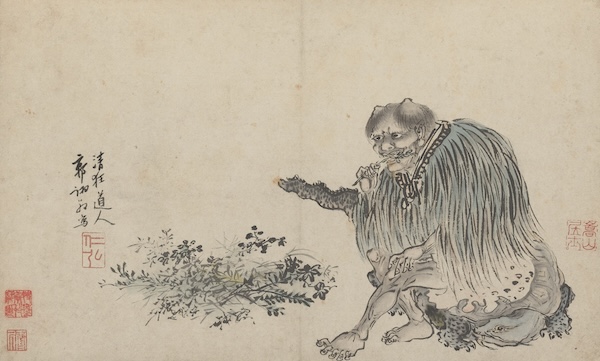
Trying to describe Shennong to a Western audience is a tad difficult. He has many traits that sit firmly in the realm of myth. For starters, his father was apparently a dragon and, besides his supernatural stomach, in some accounts he was born with the head of a dragon and the body of a human; in others he has the head of a bull. He is occasionally counted as one of the Three Sovereigns, a pantheon of divine ancestral beings that formed the first dynasty, and sometimes he’s the father of the Yellow Emperor, the originator of Chinese culture.
Culturally, he has been ascribed a number of qualities that appear to be the amalgam of many exceptional people, or indeed peoples: according to the Chinese he is responsible for inventing agriculture, herbal medicine, money and commerce, and the Chinese lunisolar calendar. At this point I wondered if he had any interest at all in the arts, and apparently he also had a hand in co-creating the guqin, a musical instrument.
Eventually Shennong meets his end during one of his herbal experiments – a fast-acting poisonous plant kills him before he can drink a cup of tea as an antidote. (Tea can solve many problems, but not all of them.) This part-dragon polymath may not have been a historical figure in the strictest sense, but the story of tea is never as straightforward as an infusion of leaves in water.