Once a leading Australian tea brand, Robur now just haunts Victoria with its ghost signs.
In the 19th century, Australians became the leading tea drinkers in the world per capita, consuming on average almost a kilo of tea per week. That fact, combined with an economic boom thanks to the Victorian gold rush, saw the start of many local tea companies including Griffiths, Bushells and Robur.
Griffiths and Bushells I was already familiar with: the former’s Sydney warehouse is now a heritage building that has been turned into luxury apartments; the latter still sells tea in Australian supermarkets, although the brand is now owned by Lipton.
Robur intrigued me. Latin for ‘strength’ and ‘vigour’ (think ‘robust’), the word was first associated with a product called ‘Tea Spirit’ advertised in an 1874 newspaper as a herbal concoction for teetotallers. In 1890, importing company Hawthorn Rhodes & Co developed it as a tea brand and sold it in 1900 to another business that became the Robur Tea Company.
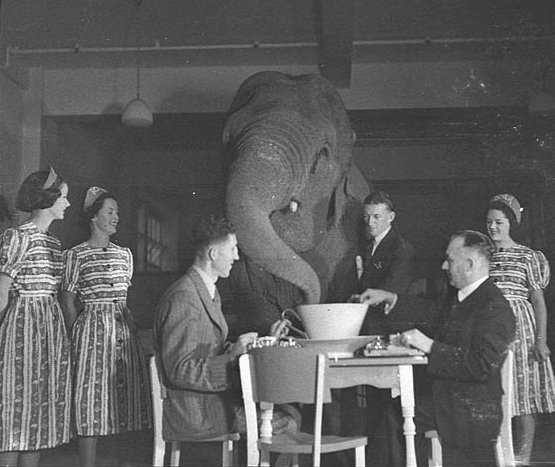
The brand was aimed squarely at the emerging middle class, presenting itself as an affordable and decent option in a contested market. Over decades, its canny advertising and marketing efforts turned it into an icon. Promotions like branded art calendars, available free from local grocers, brought the brand into many households, and stunts like inviting celebrity elephant Alice, from Wirth’s Circus, to a tea party in Sydney (see image above) ensured it received publicity.
In 1927, Robur developed and patented its Perfect Teapot, made of electroplated nickel silver, which further cemented the brand as the right balance of value and quality. The design was so successful it was still being made until 2002. Although I didn’t know the brand’s name, I have definitely seen the teapot in vintage shops.
The famous shape of its teapot became the backbone of its 1929-30 outdoor advertising campaign, an effort that still resonates almost a century later. Robur contracted signwriters Lewis & Skinner for the job; records unearthed in 2012 reveal that over 18 months, the contractors painted 541 Robur-branded teapots on walls throughout Melbourne and regional Victoria.
Tetley bought the company in the 1980s, and the brand itself was discontinued and has since been folded into the parent business’ brand. Today it exists via ghost signs throughout Melbourne, and its heritage-listed Southbank office and warehouse are now being developed into a mixed use precinct. While I’m personally too young to remember its TV ads, older folk recall “Ah Robur, it’s got the flavour that makes life worth living”.